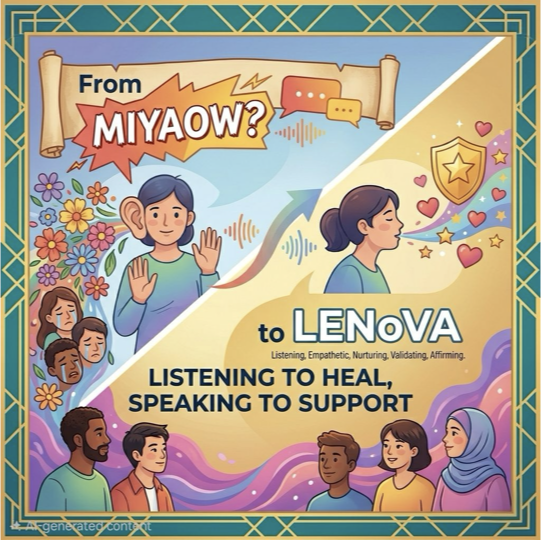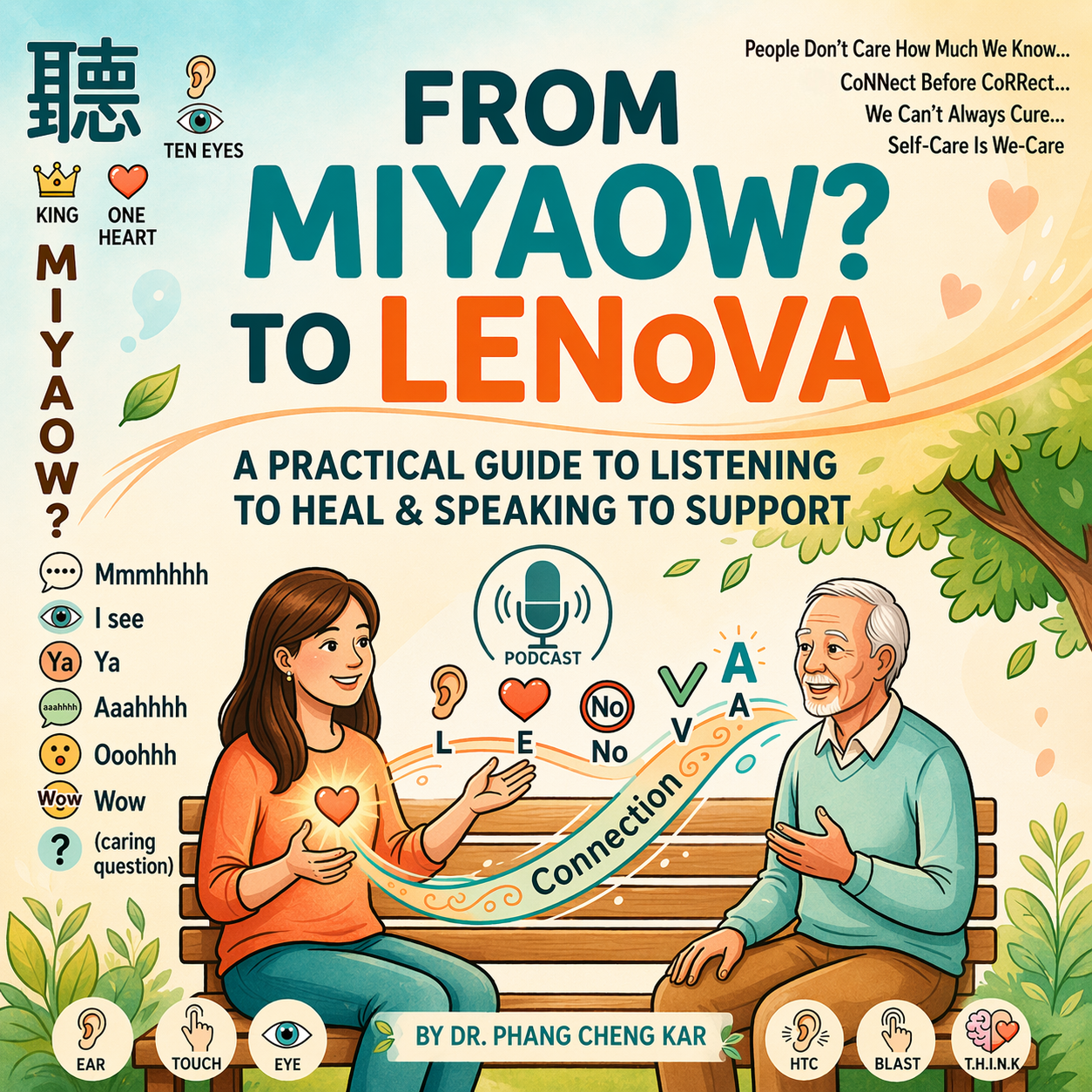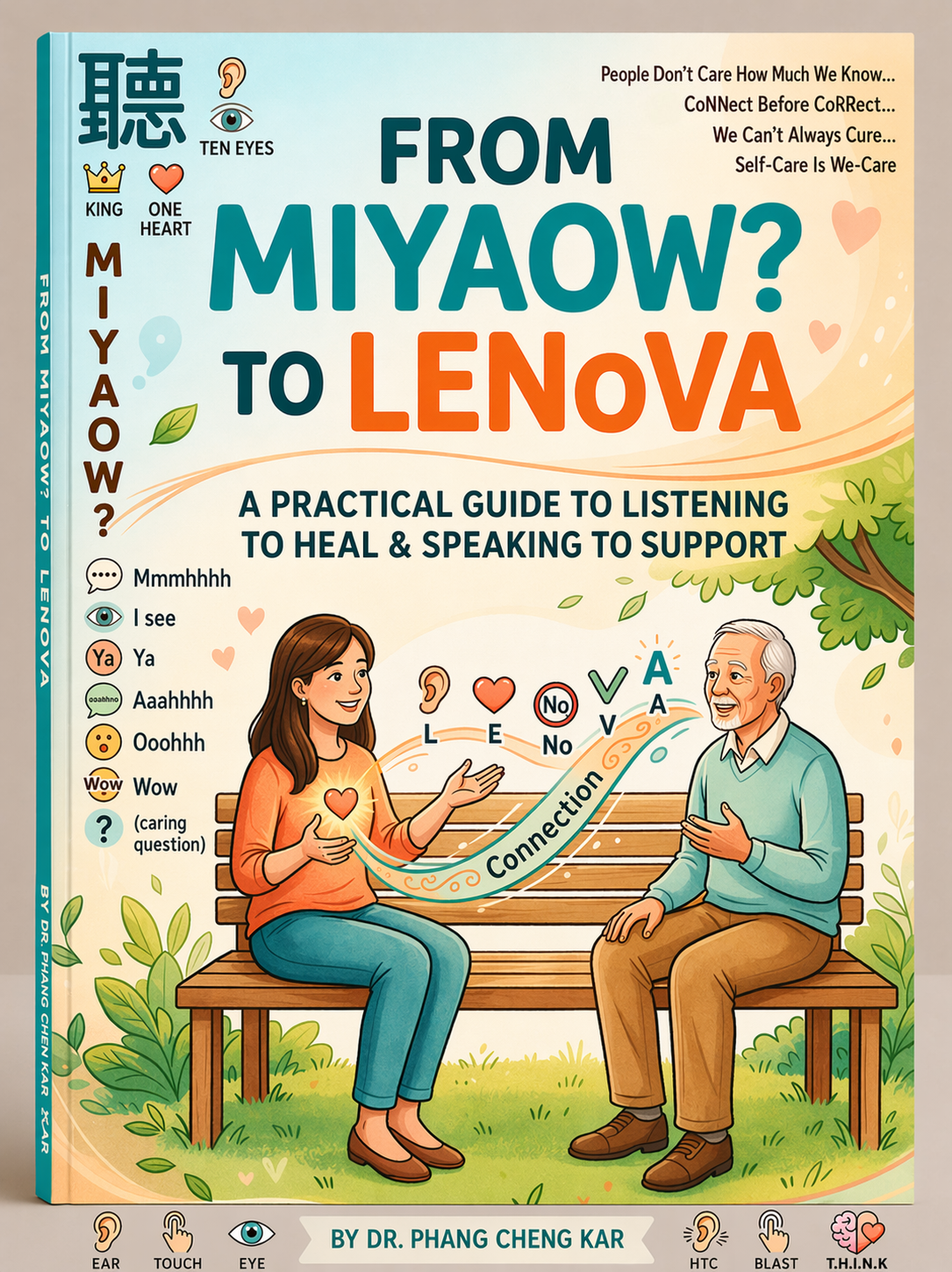
From MIYAOW? To LENoVA
Book Cover
From MIYAOW? to LENoVA: A Practical Guide to Listening to Heal & Speaking to Support © 2026 by Dr. Phang Cheng Kar is licensed under CC BY-NC 4.0. To view a copy of this license, visit https://creativecommons.org/licenses/by-nc/4.0/
This booklet is for educational and informational purposes only and is not a substitute for professional medical advice, diagnosis, or psychiatric treatment. Reading these pages does not create a doctor-patient relationship, and you should always seek the guidance of a qualified healthcare provider for specific mental health concerns. While these tools are designed to support communication, they should be adapted to your unique situation and needs. In the event of a mental health emergency or crisis, please contact local emergency services or a 24-hour hotline immediately, as this guide is not intended for use in urgent clinical situations.
This booklet is dedicated to everyone—past, present, and future—who sincerely wishes to learn the power of deep listening and therapeutic speech, especially the caregivers of my patients, whose daily commitment and tireless support make the journey of healing possible. May these pages guide you to listen with your whole heart and "connect before you correct," building the bridges of empathy and healing that transform your relationships and support those you care for.
In my daily practice, I have seen time and again that the most powerful medicine does not always come in a blister pack; it often comes from the people who care for you. Emotional support is a cornerstone of holistic treatment in my clinic. When a loved one is struggling with their mental health, the presence of a supportive family member or friend can be the very anchor that prevents them from drifting away.
However, I also witness a recurring and painful paradox. Most people come from a place of deep sincerity and a desperate wish to help, yet they often find that their efforts inadvertently make things worse. I frequently hear patients share the same heartbreaking report: "They mean well, but what they say isn't helpful—it actually makes me feel more misunderstood."
The root of this frustration is rarely a lack of love. Instead, it is a mismatch in communication—a "love language" barrier where the supporter is trying to provide solutions while the patient is crying out for connection. This leads to the questions I am asked most often: “How do I communicate with them?” “Is just listening enough?” “What exactly am I supposed to say when they are in pain?”
I have written this booklet to serve as a practical guide for those moments when words feel heavy or inadequate. It is designed to help you move from the role of a "Fixer" to that of a true "Supporter." Within these pages, you will find tools to bridge the gap between your heart and theirs. To help you remember the core principles of therapeutic speech, I have included a song titled "T.H.I.N.K. Before You Speak." It serves as a rhythmic reminder to ensure our words are True, Helpful, Inspiring, Necessary, and Kind.
As you journey through these chapters, I ask you to keep one thing in mind: every person and every relationship is unique. While these principles are evidence-based and time-tested, they are not a "one-size-fits-all" formula. I encourage you to individualize these tools to meet your loved one's specific needs and temperament.
Healing is a collaborative journey. My hope is that this guide empowers you to listen with your whole being and speak with a heart that heals, transforming your support into the bridge that leads your loved ones back to wellness.
I wish to express my deepest gratitude to the teachers and wisdom traditions that have guided me toward a path of deep, mindful, and compassionate communication. I am especially indebted to the late Vietnamese Zen Master Thich Nhat Hanh for his profound teachings on deep listening and the art of presence. I also want to acknowledge the foundational frameworks of Dialectical Behavior Therapy (DBT), Nonviolent Communication (NVC), and Motivational Interviewing, which have provided the essential pillars for the principles shared in this guide.
To all my patients, clients, and individuals in need whom I have had the privilege to support: thank you. Your courage in the face of vulnerability has been my greatest classroom. You have helped me sharpen these skills and have deeply informed the approach I take within these pages. Your journeys are the heart of this work.
Lastly, I am grateful for my own empathic nature. What I once perceived as mere sensitivity, I now recognize as a vital professional gift. Being an empath allows me to feel the weight and resonance of words with heightened clarity; it acts as a natural feedback loop, helping me stay attuned to how our speech meets—or misses—the deep human needs of others. This innate sensitivity is the compass that ensures my communication remains rooted in genuine connection and healing.
Welcome to the Heart of Connection
The Shift: From "Fixer" to "Supporter"
The Four Pillars of Heart Connection
The Ancient Roadmap of 聽 (Tīng)
Decoding the Character 聽 (Tīng)
5 Reasons Why Advice Too Soon Can Be Unhelpful
Beware of "Camouflaged Advice"
Our Heart Mantra: CoNNect First, Before You CoRRect
Listening with Your Whole Body
The BLAST Upgrade: Dual Attention
E – EMPATHY (Feeling With Them)
NO – NO ADVICE (The Golden Rule)
V – VALIDATION (Making it Normal)
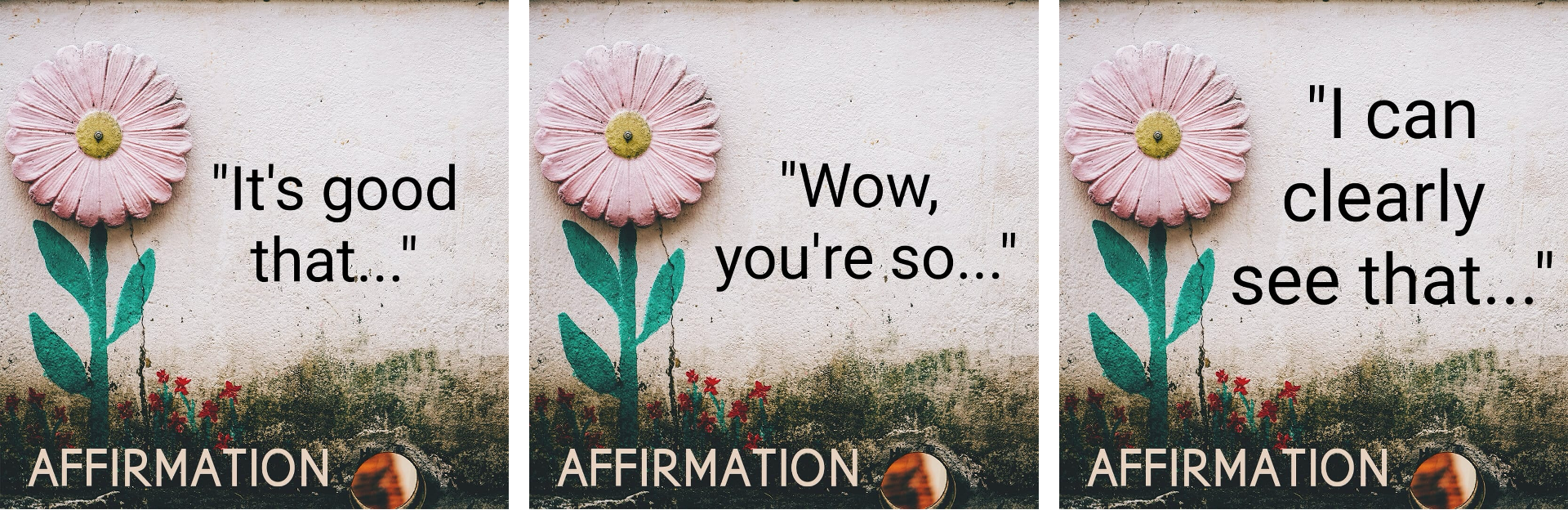
A – AFFIRMATION (Finding Strength)
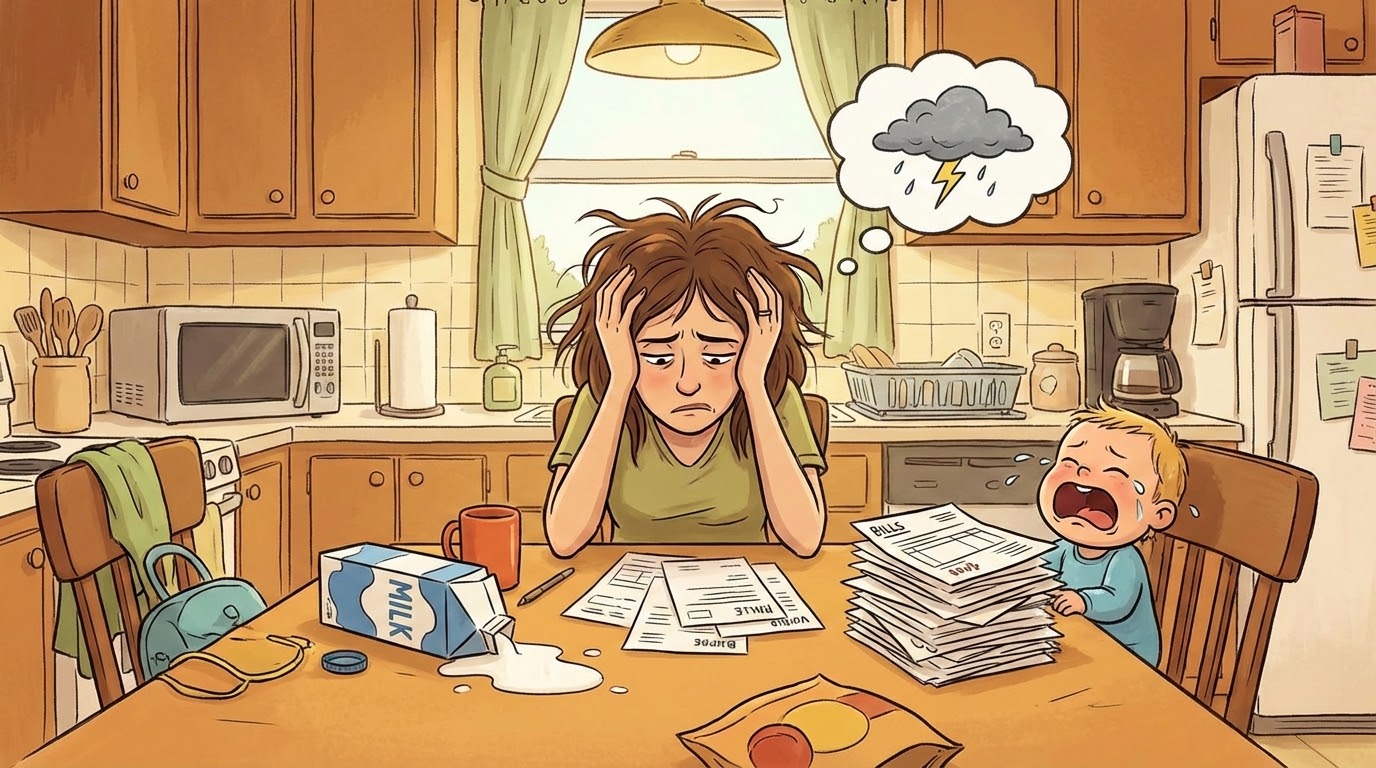
Putting it All Together – The Mother in Distress
The "Fixer" Way (The Advice Trap)
The Mindful Way (Using Our Tools)
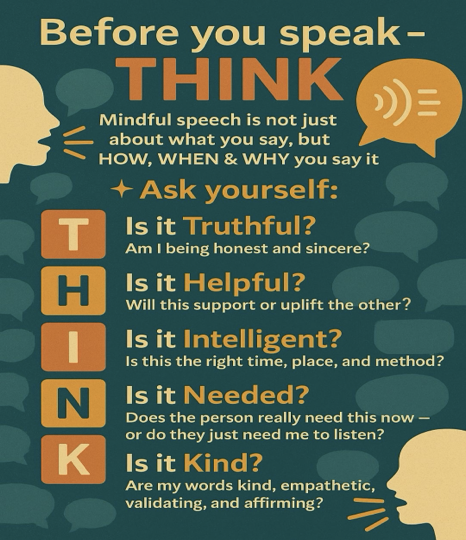
The T.H.I.N.K. Filter for Mindful Speech
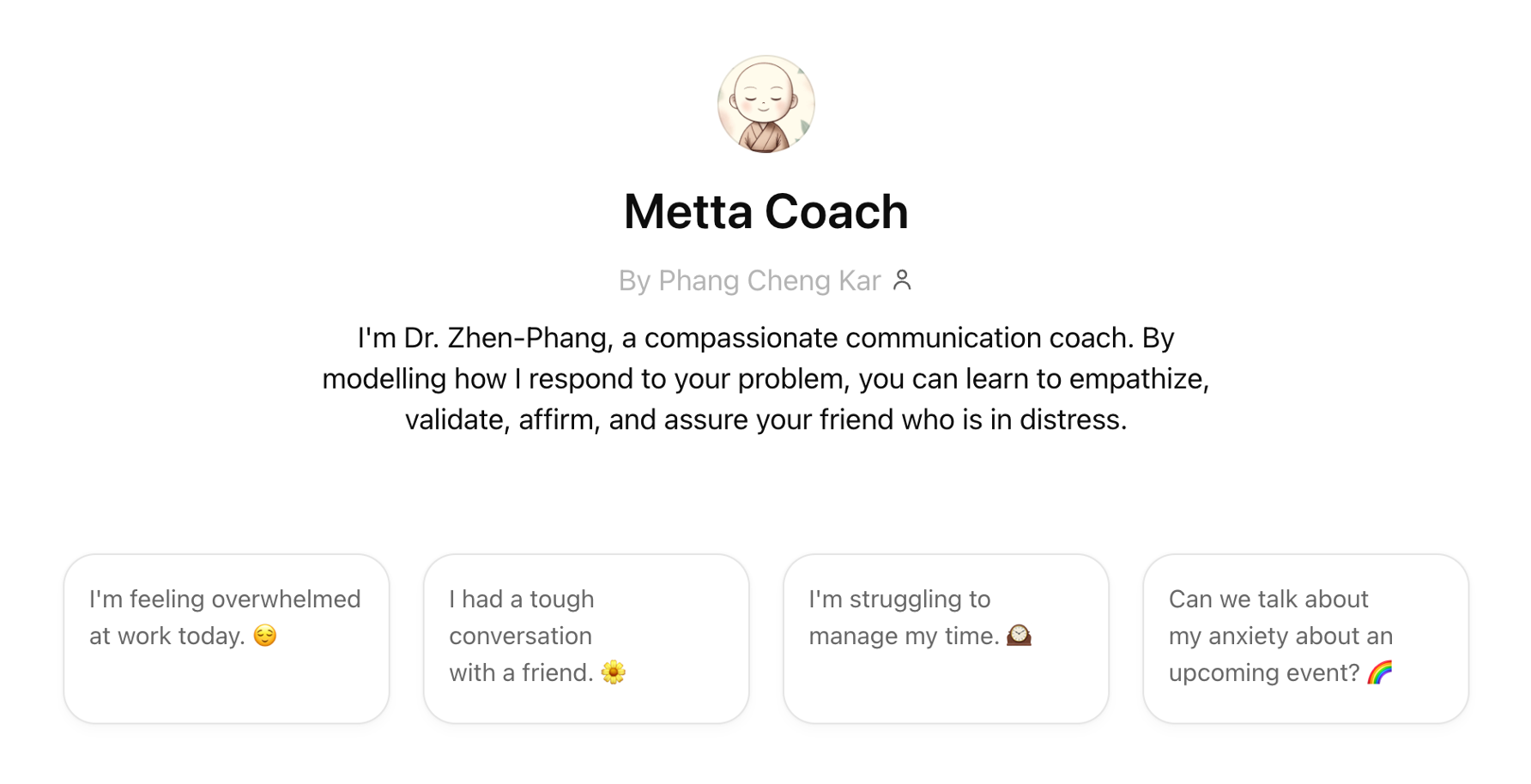
For ChatGPT Plus Users: The Metta Coach GPT
For Free Users: The "Copy & Paste" Prompt
A Final Message from My Heart to Yours
Welcome, my friend. I am so glad you have picked up this booklet. It tells me one very important thing: you care.
You might be here because someone you love is struggling. Maybe it is a teenager who has stopped talking to you, a friend facing depression, or a colleague who is burnt out. In these moments, we often feel a heavy weight in our hearts. We want to help, but we often think, "I honestly don't know what to say or do".
If you have felt this way, please be kind to yourself. It is a very human feeling.
Most of us have a "Fixer" inside us. When we see someone crying or stressed, we want to pull out the "nail"—the problem—right away. We jump in with advice because we have good intentions.
But in this workshop-in-a-book, we are going to learn a different way. We are going to learn how to move from being an expert who "fixes" things to being a companion who "supports" people.
Before we start, let’s hold these four "Heart Mantras" close. They will be our guides through every page:
In the chapters ahead, I will share two main practical tools and two important sub-tools to help you "actionise" our heart mantras. These tools will give you a clear path to follow when you are supporting someone in distress:
By learning these, you will have a complete "first-aid kit" for the heart. We will learn to stay grounded (HTC), listen deeply (MIYAOW?), build a bridge of support (LENoVA), and speak with wisdom (T.H.I.N.K.).
I am a psychiatrist, but I am also a fellow traveler on this path. I have made mistakes, and I have learned that the greatest medicine we can give another person is simply our One Heart.
Let’s begin.
Before we can help anyone, we must first learn the art of being still. In our busy lives, we often "hear" sounds, but we do not truly "listen" to the person.
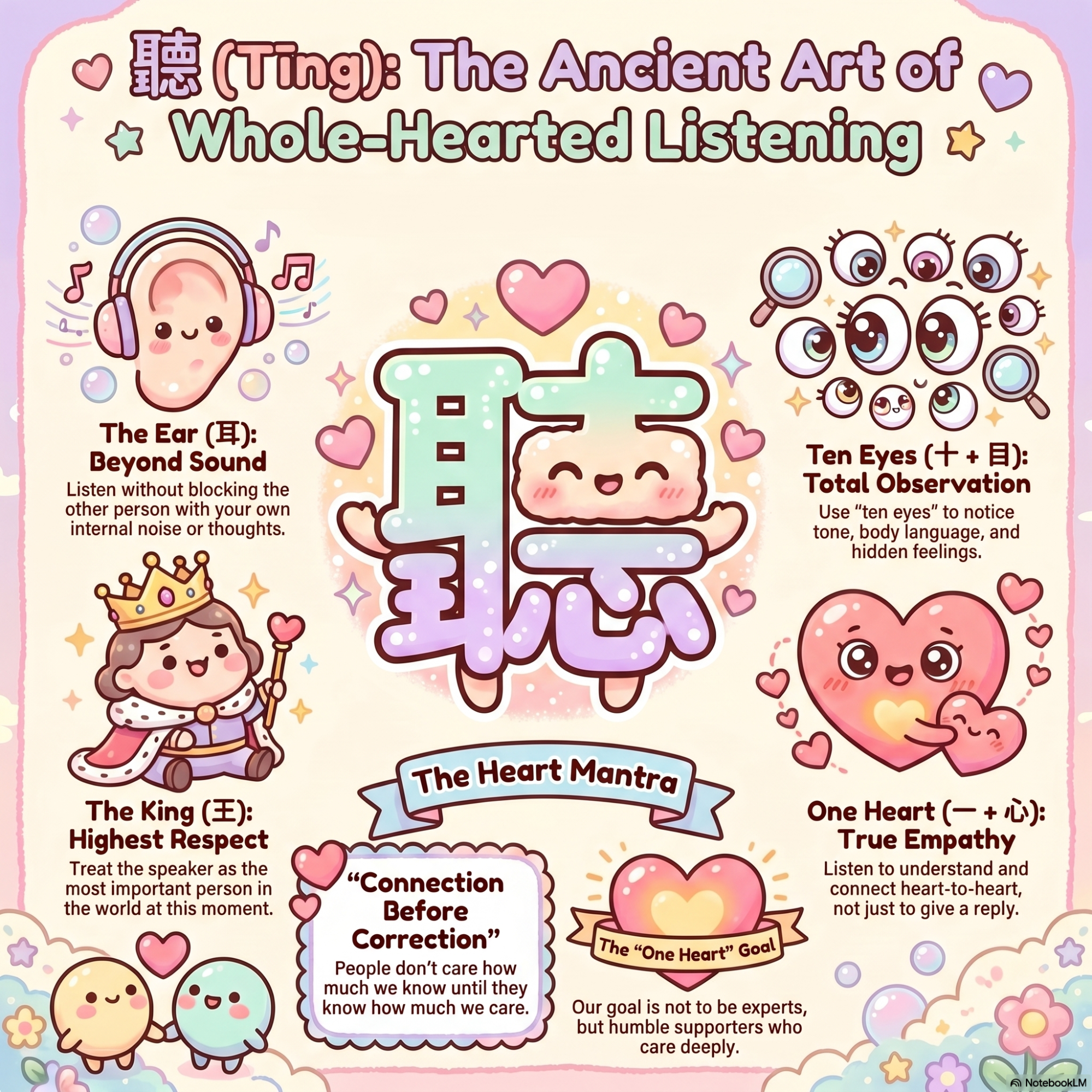
To help us understand this, I want to show you a very old and beautiful Chinese character for listening: 聽 (pronounced as tīng). This character is like a small map for our hearts. It shows us that listening is not just about our ears; it is about our whole being.
Let’s look at the pieces of this character together:
You might wonder, "Why do I need to listen like this?"
The answer is in our first mantra: People Don't Care How Much We Know, Until They Know How Much We Care.
If I come to you as a doctor or a friend and start giving you a lot of knowledge or facts, it might not help you feel better. But if I listen to you with my "One Heart," you feel that I care. When you feel that I care, the door to your heart opens. Only then can we walk together toward healing.
In this booklet, we remember that our goal is not to be experts who know everything. Our goal is to be humble supporters who care deeply.
Have you ever been talking to someone about a problem, and before you could even finish your sentence, they said, "You know what you should do..."?
How did that feel? Usually, it doesn’t feel very good. It can feel like the other person is rushing you, or like they think your problem is very easy to solve.
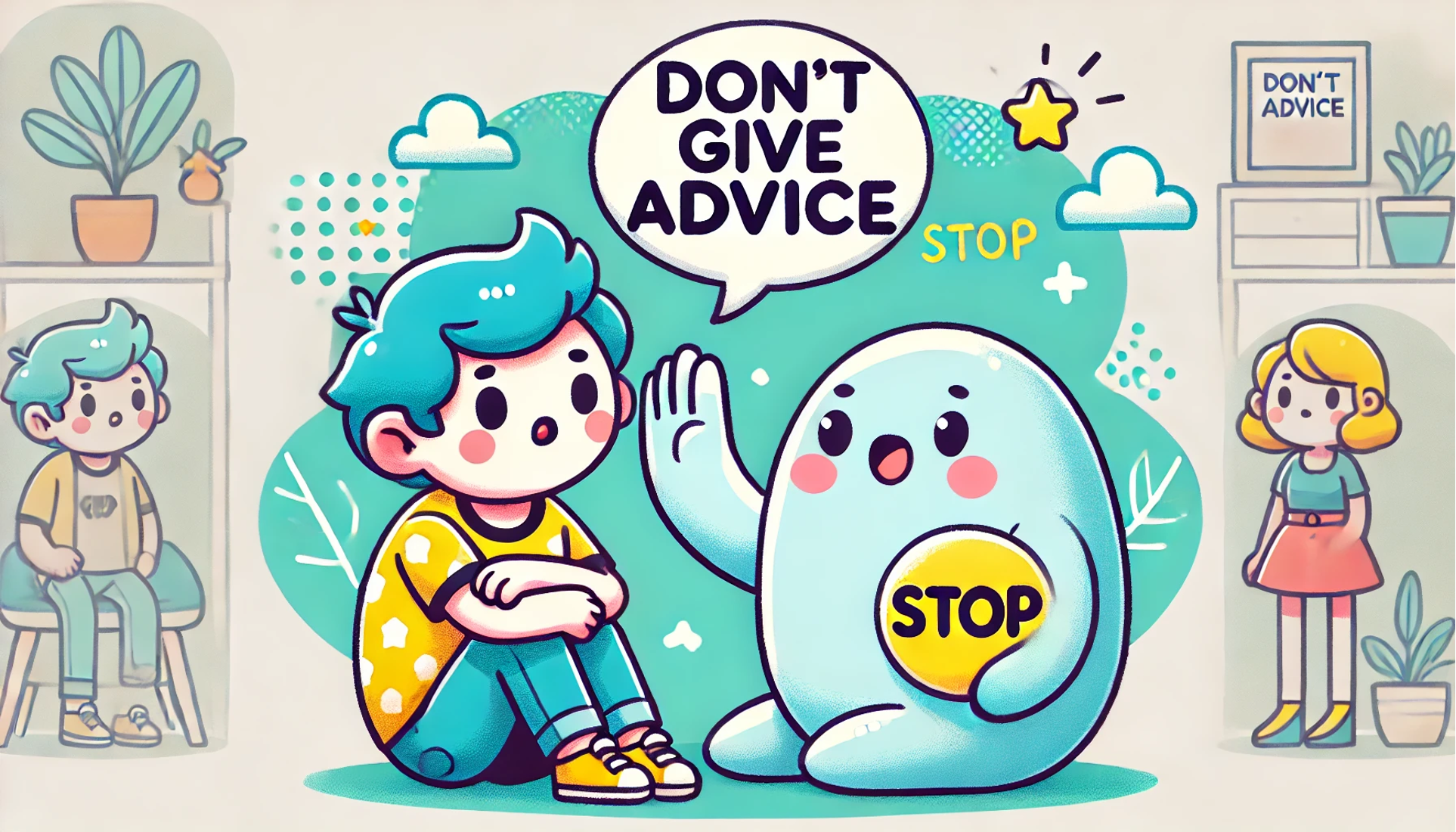
I call this the Advice Trap. Because we care about the people in our lives, our "Fixer" instinct wakes up when we see them in pain. We want to help, so we reach for a solution. But if we give advice too quickly, we often break the connection.
Sometimes, we try to hide our advice so it doesn't sound so bossy. We call this Camouflaged Advice. These are phrases that look like support but are actually just advice in disguise:
Even if these words are spoken softly, the person listening can still feel the "Fixer" trying to take control.
This leads us to our second big lesson: CoNNect First, Before You CoRRect.
In a workshop, if a teacher tries to correct a student's mistake before the student even knows the teacher's name, the student will feel bad. But if the teacher builds a relationship first, the correction feels like help.
It is the same with our loved ones. We must spend time "connecting" with their feelings through deep listening. Only when the connection is strong, and they ask for it should we move toward "correcting" or offering solutions.
Now that we understand the power of listening with our whole heart, you might ask: "If I am not talking or giving advice, what should I do?" The answer is to keep the "bridge of connection" open. To help you understand this, I want to share a story I call "The Nail in the Forehead."
Imagine a woman sitting on a couch, clearly in pain. She says, "I feel so much pressure in my head. It’s like a constant tugging." You look at her and see a large iron nail protruding from her forehead. It is so obvious! You want to say, "There is a nail in your head! Let’s pull it out!" But every time you try to mention the nail, she gets upset. She says, "You’re not listening. I’m just telling you how I feel. I don't need you to fix it, I just need you to hear me."
https://youtu.be/-4EDhdAHrOg?si=slz0uV8BipILtefv
In this story, the "nail" is the problem we want to fix. But for the speaker, the "nail" isn't the priority yet—her feelings are. If you rush to fix the nail, you miss the person. We must stay on the bridge of connection until she is ready to talk about the nail herself.
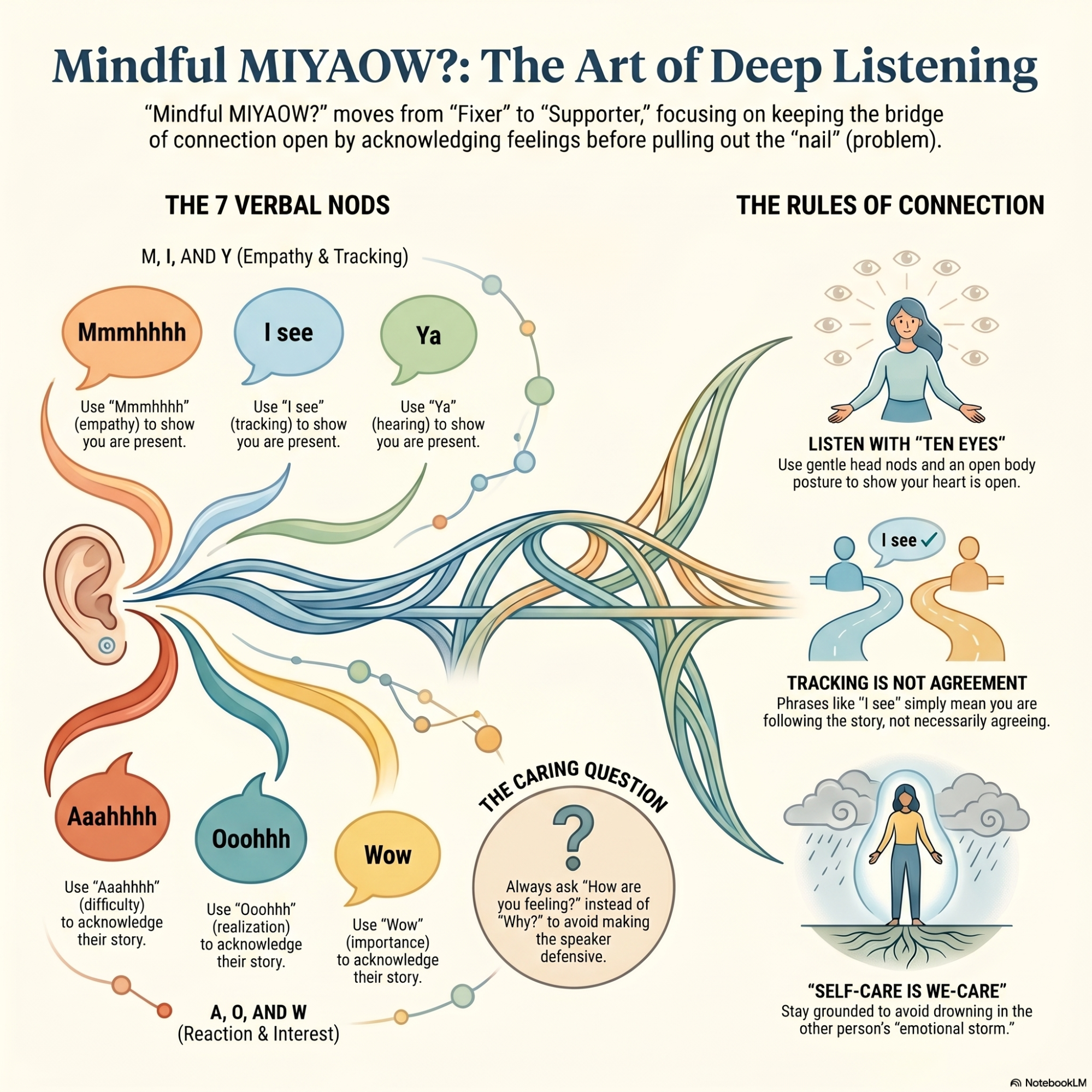
This is why we use our first practical tool: Mindful MIYAOW?.
These are short sounds or words that show the "King" you are right there with them, without trying to "pull out the nail" too soon.
Even with a good heart, we can make mistakes. Let's look at these humbly so we can improve:
The character 聽 (Tīng) also mentions "Ten Eyes." This means we use our eyes to show we are listening.
Always remember our mantra: We Can’t Always Cure, But We Can Always Care. Your open body and your genuine sounds of support are the simplest ways to show that care.
Listening to someone in deep pain can be very heavy. Sometimes, when we listen to a friend who is crying or a family member who is very angry, we might feel like we are "drowning" in their emotions. Their sadness becomes our sadness, and their stress becomes our stress.
When this happens, we lose our ability to help. This is why we must practice our fourth mantra: Self-Care Is We-Care. If you do not take care of your own peace, you will not have enough peace to share with others. To be a strong "bridge" for someone else, you must first be anchored to the ground.
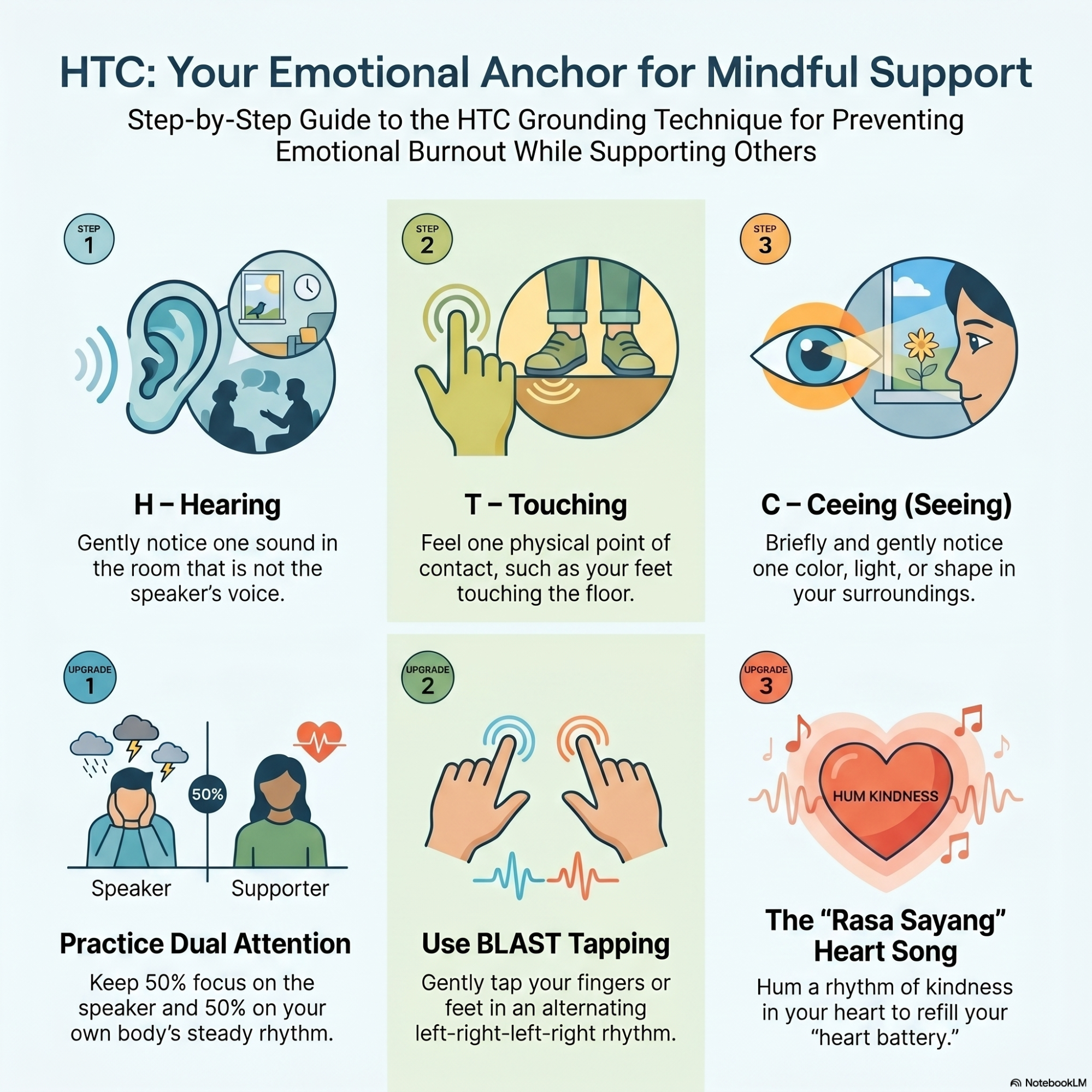
While you are listening with your One Heart, you can quietly use a tool called HTC. This helps you stay in the room without getting lost in the other person's "emotional storm."
You don't need to close your eyes or stop listening. You can do this intermittently while the other person is talking:
By doing this, you are keeping one foot in their world to care for them, and one foot in your own world to stay steady.
If the person’s distress is very strong, you can "upgrade" the T (Touching) into something called “Bilateral Alternative Stimulation Tactile” (BLAST). This involves gently and slowly tapping your fingers, hands, or feet in an alternating rhythm: left, right, left, right. This creates Dual Attention:
A wonderful way to use BLAST is to combine the tapping with a song of kindness. In our hearts, we can quietly hum the ‘Mettā’ (Loving-Kindness) version of a famous Malaysian folk song:
"Rasa sayang hey, Rasa sayang, sayang hey,
Hey, may I, may you, may all be happy, Happy, HAPPY…"
As you tap left-right-left-right to this rhythm, you are not just grounding your body; you are filling your own "heart battery" with compassion. You are wishing well for yourself, for the person in pain, and for everyone.
Remember: We Can’t Always Cure, But We Can Always Care. If you get sucked into their storm and start panicking too, you can no longer provide a safe space.
By using HTC, BLAST, and the Rasa Sayang rhythm, you are protecting your own energy so that you can continue to be a lighthouse for them. You stay calm, so they can find their way back to calm. That is the true meaning of Self-Care Is We-Care.
Here is a beautiful song to remind us of the importance of self-care:
🎶 Self-Care Is We Care https://on.soundcloud.com/sWln7nrPJzgV28Rsbs
Now that we have practiced staying grounded with HTC and listening with MIYAOW?, we are ready for the next step. Eventually, the silence will end, and you will need to speak.
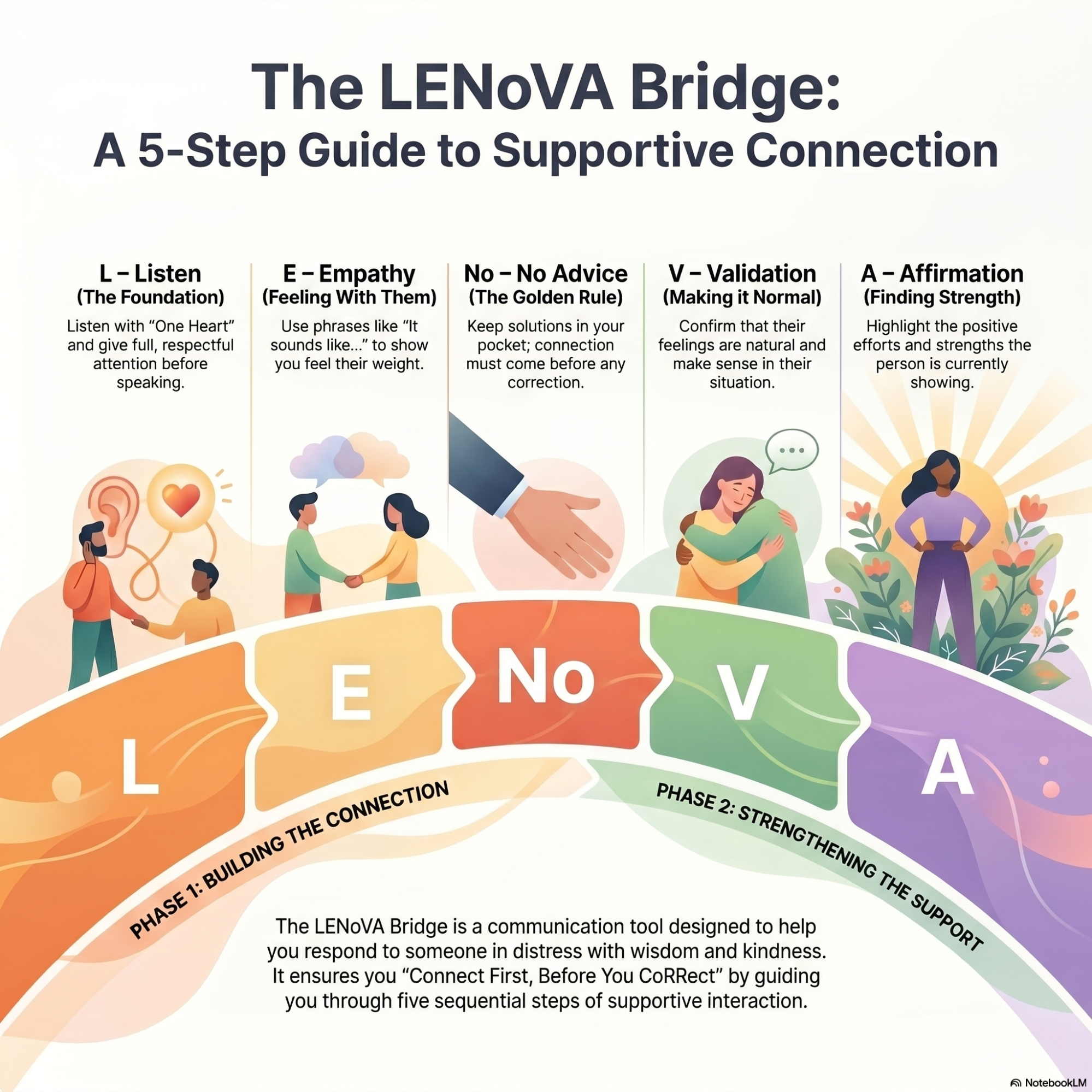
How do we move from listening to speaking without breaking the connection? We use a bridge called LENoVA.
This tool helps us stay humble and helpful. It ensures we continue to follow our mantra: CoNNect First, Before You CoRRect.
The first letter of our bridge is L for LISTEN. This is the most important part. Before you say anything else, you must use your Mindful MIYAOW? habits. You must treat the person like a King and listen with your One Heart.
If you skip this step, the rest of the bridge will fall down. Remember: People Don't Care How Much We Know, Until They Know How Much We Care.
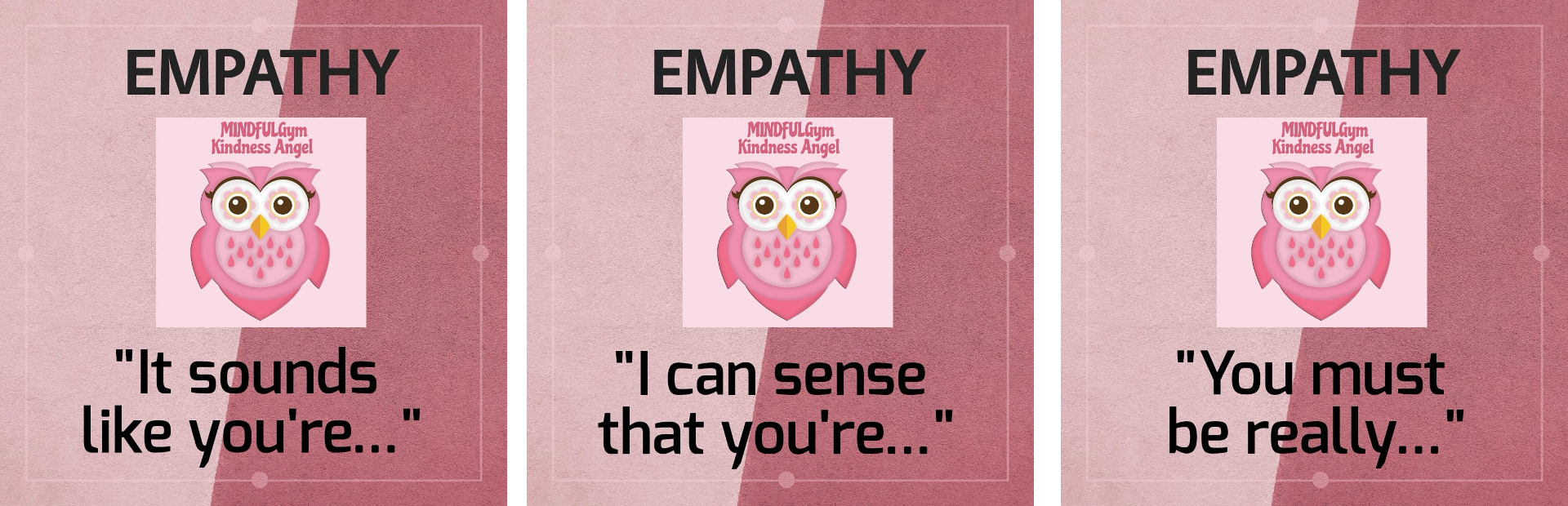
Empathy means trying to see the world through their eyes. It is showing them that you feel the "weight" they are carrying. You can use simple phrases like:
This is the hardest part! Even when we start talking, we must remind ourselves: No Advice. Remember the story of the Nail in the Forehead. If you jump to a solution too fast, the person feels you are not listening to their heart. Keep your advice in your pocket for now. We focus on caring, because We Can’t Always Cure, But We Can Always Care.
You might ask, "Dr. Phang, will I ever give advice?" Yes, but only when the time is right. Wise and compassionate advice follows three rules:
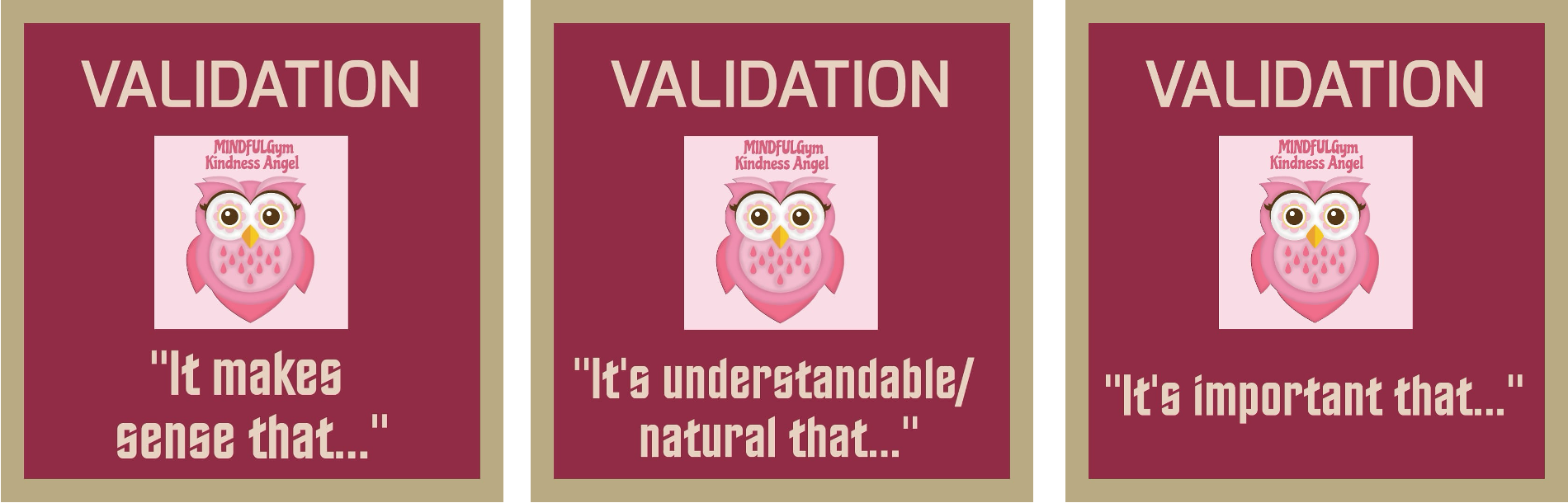
Validation is telling the person that their feelings make sense. You are not saying they are "right" or that you "agree" with everything they did. You are just saying their feelings are natural.
Finally, we help the person see their own strength. We highlight the good things they are doing, even in hard times.
By using the LENoVA bridge, you ensure that your words are always kind, humble, and supportive. You are not just a "fixer" anymore; you are a true companion.
To help you see how these tools work in real life, let’s look at a common situation.
Imagine you are visiting a friend. As soon as you sit down, she starts to cry. She says, "I can’t do this anymore. My teenage son is always shouting at me. I feel like a failure as a mother."
Your heart hurts for her. You want to help. Let’s see the difference between being a "Fixer" and being a "Supporter."
As a Fixer, you might say:
Even though you want to help, she might feel unheard. She might stop talking and feel even more alone.
Now, let’s try it again using MIYAOW?, HTC, and LENoVA.
Before you speak, you notice your own heart is beating fast because you feel her pain.
As she speaks, you treat her like a King. You use your "Ten Eyes" to see her tears and your "One Heart" to feel her stress. You don't interrupt. You use your verbal nods:
When she pauses, you use your words to support her:
After you say this, your friend takes a deep breath. She might cry a bit more, but then she looks at you and says, "Thank you for listening. I feel a bit lighter now."
Because you followed our mantra—CoNNect First, Before You CoRRect—she feels safe. You didn't "cure" the problem with her son yet, but you did something more important: you cared.
Remember: People Don't Care How Much We Know, Until They Know How Much We Care. By listening with your One Heart, you have given her the strength to keep going.
We have learned how to listen with our One Heart and how to build a bridge of support with LENoVA. But there comes a time when we must share our own thoughts, or perhaps give the advice we have been holding back.
How do we make sure our words are a gift and not a weapon? Before you speak, I want you to use a final filter called T.H.I.N.K. Think of this as a "security guard" at the door of your mouth. Before any word goes out, the guard asks five simple questions:
Because it's hard to remember these five things when we're busy or stressed, I've written a simple song to help you. It's a melodic reminder to pause. When you feel the urge to speak quickly, try to hum the rhythm of the THINK song in your heart. It will give you the few seconds you need to check your words.
By using this filter, you ensure that even your "corrections" or "advice" are wrapped in kindness.
You can listen to the song here:
THINK Before You Speak 🧠 | Mindful Communication Song (A Cappella)
Now you have the full circle:
Through this whole process, we keep our humble mantra: We Can’t Always Cure, But We Can Always Care. Your words might not solve every problem today, but if they're Truthful, Helpful, Intelligent, Necessary, and Kind, they will always be a form of care.
And as we discussed, please be patient. Learning this new "language" of mindful speech takes time. It is like learning Pali—you start with one word, one "Mmmm," and one "Is it Kind?" at a time.
Learning the language of the heart takes practice. Just like learning Pali, you need a place to try out your new words and habits without fear of making mistakes.
To help you, I have created a digital companion called the Metta Coach. Think of it as a "practice partner" that never gets tired and is always ready to help you build your "emotional muscle."
https://chatgpt.com/g/g-Nuz1UoDF5-metta-coach
If you have a ChatGPT Plus account, you can access a specialized, customized GPT that I have designed specifically for this workshop. It is programmed to act as a compassionate coach. When you share a problem with it, it will model the LENoVA steps for you, showing you exactly how to empathize, validate, affirm, and assure.
If you do not have a Plus account, you can still turn the standard ChatGPT into a Metta Coach! Simply copy and paste the text below into your chat:
After I have shared my problem with you, act as a counselor and respond to me in four specific ways: empathize, validate, affirm, and assure, clearly stating the mode I'm using and adding comforting emojis to enhance the warmth and support of my responses. For empathy, use phrases like 'You seem to be...', 'It sounds like...', and 'I can sense that you're...'. For validating feelings, use 'It's natural that...', 'It makes sense that...', and 'It's important that...'. For affirming, use 'It's good that...', 'I can see you're trying hard.', and 'Wow, I'm impressed by your...'. For assuring, use 'Slowly but surely, you will...', 'No matter what happens, I'm here for you...', and 'I'm confident you can...'.
After each response, you will present the following numbered options in separate lines for clarity:
1) Would you like to have an alternative set of responses?
2) Would you like to know the purpose of each response?
3) Would you like to share more about how you feel or think?
4) Would you like me to give you case scenarios for practice?
When providing case scenarios, you will focus on one task at a time, either empathize, validate, affirm, or assure, to enhance learning.
As you close this booklet, remember that being a mindful communicator is not about being perfect. It is about being present.
Don't worry if you stumble. Don't worry if you find it hard to stop giving advice at first. Just keep these four mantras in your heart as you go:
You have the tools. You have the heart. And now, you have a practice partner. Take your time, be patient with yourself, and remember that every "Mmmhhhh" and every kind word is a step toward healing.
Thank you for your One Heart. May you and your loved ones find peace and connection.
Dr. Phang Cheng Kar, a respected consultant psychiatrist at Sunway Medical Center in Malaysia, is also the visionary founder of MINDFULGym. This program is recognized as Malaysia’s leading evidence-based initiative for stress reduction and wellness promotion through mindfulness. Additionally, Dr. Phang is the founding president of the Kuala Lumpur Buddhist Mental Health Association (BMHA).
Dr. Phang is a dedicated medical doctor, psychotherapist, and teacher whose extensive work showcases his commitment to emotional well-being and mindfulness. Through an engaging, distinctive, and creative approach, he has authored numerous books and articles. His methods are designed to empower individuals to achieve enhanced mental clarity and inner peace by overcoming limiting beliefs and transforming stress into valuable lessons.
In recognition of his extensive community work in promoting mental wellness and mindfulness, Dr. Phang received the Social Action & Responsibility Award from the Nalanda Institute Malaysia in 2017.
Outside of his professional work, Dr. Phang is a keen composer of AI music for education and actively shares mindfulness as a way of life with his patients, friends, and the broader community.
1. CoNNect Before You CoRRect: Listen to a podcast discussion drawing from the themes and concepts of this ebook.
2. From MIYAOW to LENoVA: Mastering the Language of Emotional Care
3. LENoVA (Connect) + NVC (Solve Conflict): The Secret to Talking So Teens Actually Listen https://youtu.be/XqCoFs6bUgg
4. From Fixing to Connecting: A Mum’s Journey Through Mindful Listening
https://youtu.be/0r1w-wKzZuU?si=OahxPHXVIE1oz8Lx
5. Mindful Parenting + Non-Violent Communication: From Conflict To Connection https://youtu.be/uTysfGASiXw?si=O73TVTs1US8Bk6Lb
6. "Mini NVC": The Secret of Practicing Nonviolent Communication Quickly & Naturally https://youtu.be/VsuwA8IjMto?si=4jIp5SaPm8ZRc9Dr
7. The Art of "Mini NVC": Quick & Kindful Ways To Apply Nonviolent Communication
Listen to this tab